Friday, March 2, 2018

Chasing Diversity...


Swaroopa from Bhoomi College, Bangalore approached  BuDa Folklore as a part of her 2 months internship  and stayed with us in Angadibail forest and Honnavar for one and half months  and wrote her experience with  BuDa folklore 


Diversity is what attracts me and one of my interests has been plants and food.  My curiosity increased when I came across people mentioning a lot about the uses of uncultivated plants/weeds during our farming module at Bhoomi college. I had seen my mom and grand-mom using some uncultivated plants for cooking and over time I had moved away from my hometown and noticed that I was forgetting whatever little bit I knew about these weeds. 

So, when we were given two months of internship time at Bhoomi College I couldn’t stop myself from looking out for places where I could learn about these weeds, visit different places and meet new people. That is how I spoke to Dr.Savitha Uday (we fondly call her Savitakka), founder of BuDa Folklore and landed up at BuDa Folkore spending half the time at Honnavara and the other half at Angadibail during my internship period.

After my college days, it was the first time for me to go alone leaving behind family and friends for one and half months due to which I was a bit skeptical as to how my internship would pan out. But as soon as I reached BuDa at Honnavara I met Shanthi Nayak( we fondly call her Shantiamma), Savithakka’s mother who is a walking encyclopedia extremely passionate about her work.


Soumya

Soumyakka (one of the integral members of BuDa, manages almost everything @BuDa) informed me to get ready quickly to join the river route trek, which is part of the study tour conducted for school kids by BuDa. I did not know how to react when she showed my room which was next to an in-house museum. Too many exciting moments in a short time. After making a silent promise of coming back and seeing the museum properly I left for the river route with Atmeeya whom I can call as an ecologist because of the amount of knowledge he has regarding the environment, wildlife, and many others. 


River Sharavati 


River Sharavati


 paddy fields 

sand mining at sharavati river 

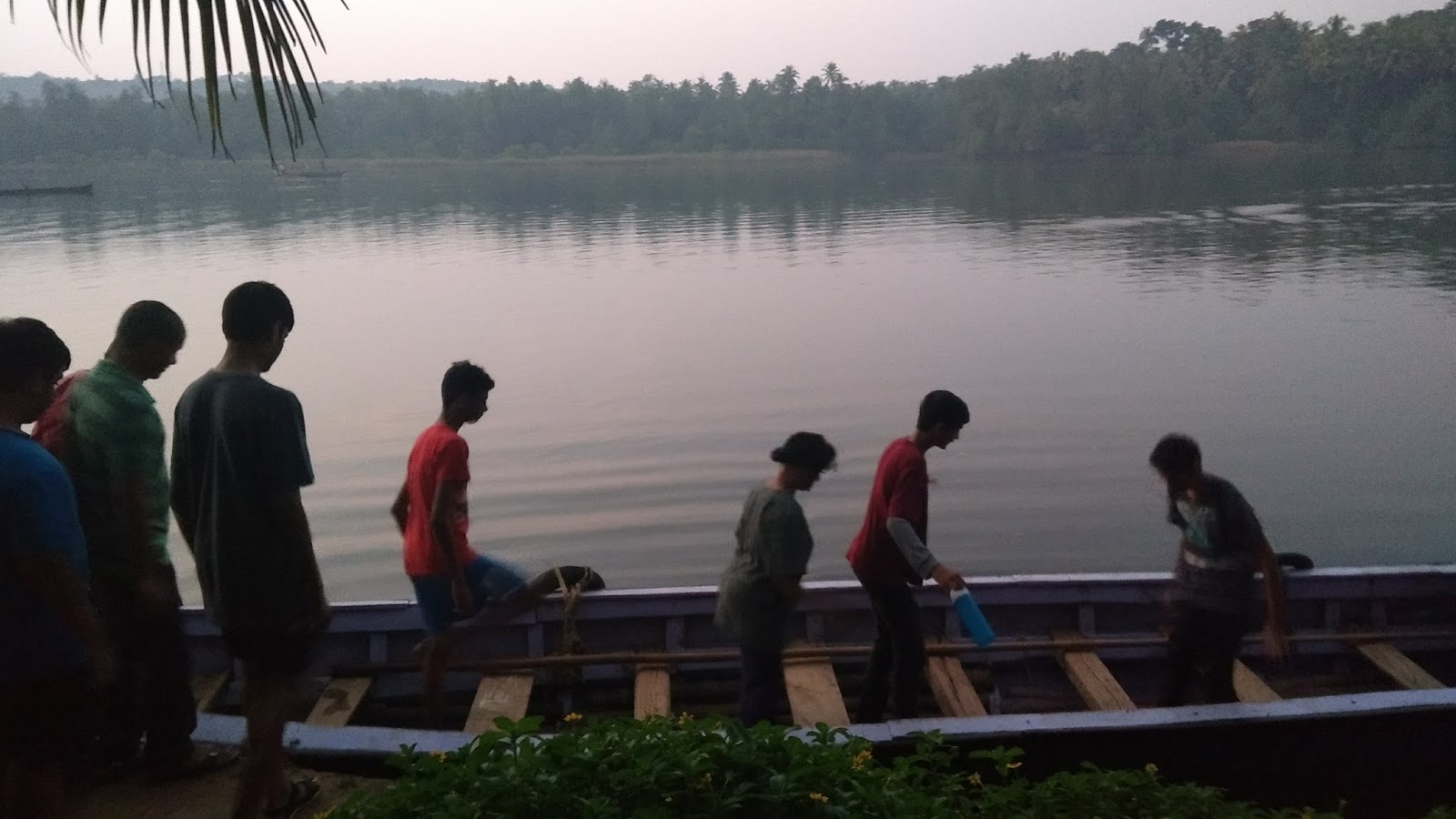
This river route was basically a trail along the river Sharavathi almost from her source to destination exploring the nature, history, livelihoods of people on the way. It was a great learning experience for me as I got to see quite a few interesting plants while walking along the farms where paddy was just harvested. Small-scale Sand Mining using just a long stick and a bucket mechanism was done near a place where we camped. 


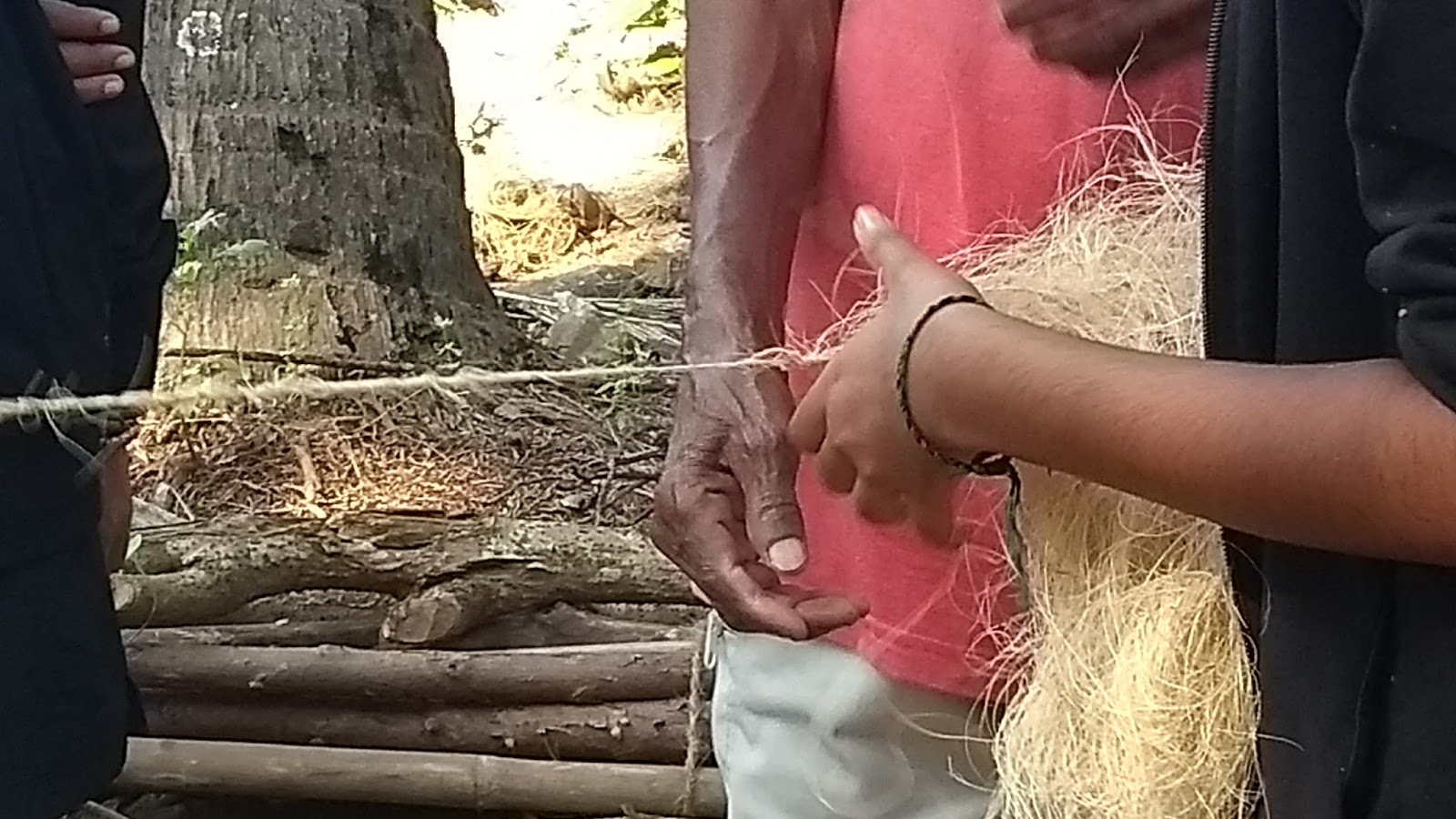
Salwador teaching coir rope making


Coir  rope making 

Got to know the method of preparing ropes from coconut coir. Coconuts were soaked in water for at least nine months in large pits which is dug during low tide. After which the shell becomes very soft and the fibers are cleaned, beaten, dried and ropes are formed using a spinning wheel. Rope obtained after this process just fetches around Rs5-10 per meter. And I could see how this art of rope making is slowly losing its importance because of plastics.

Angadibail

For the upcoming study tours, I had to be in Angadibail. I visited Angadibail for the first time during the night and it was pitch dark when I reached the place. The moment I looked at the sky I felt as though I was in a natural planetarium. With no electricity, it took a while for me to adjust to the darkness.
Angadibail

Mornings in angadibail

 Waking up to the call of Malabar whistling thrush, spending some time with Beera (pet dog) and Bella & Thuppa(two cats) and sleeping hearing to the sounds of insects, Beera's growling, cats jumping became a routine in Angadibail.  Preparing herbal tea and different flavors of ragi drink became my responsibility.


Eshwaranna

Baby akka and gouri akka 


Kafeel


padmavati akka and parvati akka 


Preparing food 


Making firewood choola with gouri akka 


Got to know few lovely and talented people like Ishwaranna who takes care of almost everything at AngadiBail, Kafeel.. a traveler who has been in Angadibail for almost 8 months, GauriAkka and BabyAkka who braved to cook food on firewood regularly without whom we wouldn’t have got yummy food.

Paddy harvesting


vegetable patch


Basket weaving


Brick making


Learning siddi dance 


Trek to Yana

Trek to vibhuti falls

Study tours turned out to be a great exploration for me where I witnessed many things for the first time. Interacting with school children, getting to know about quite a few birds and seeing so many colorful dragonflies, learning damami dance of siddhis, setting up the vegetable patch, learning basket weaving from Ishwaranna which is made using vines, mud brick making, hiking to Yaana and Vibuthi falls which I wanted to visit for so many years, harvesting paddy which I gave up after an hour of working in the hot sun, deskinning arecanut which I had seen at my grandmom’s place but had never tried are few of them.


Learning local crafts 
BuDa is creating awareness about these livelihoods among the kids, trying to bring back respect to the talent these master craftsmen possess which will help in reviving the art someday. I had the chance to interact with three groups of students of different age groups and realized how we change as we grow, how various filters and lenses automatically come in. It was interesting to observe the behaviour of children of different age groups.  I was amazed by the kind of energy kids had throughout the day, their innocence and curiosity, asking or demanding for things without fear, finding ways to have fun and of course finding new ways to bug us.

Sharing Circle


 Circle time was regularly held which I had experienced for the first time only in Bhoomi.  After so many days I realized the importance of just stating our feelings and why it is so important to develop this habit among children.
 Initially, when I was asked to help in the study tours I was not sure given my zero-experience working with kids. But I just went with the flow, got so involved that in some cases felt a whole lot of vacuum when the kids group left.    


Purlakki story from nugli akka 


Government school children curious about local art with antara and padmavati akka 


Community library 


Story telling -Gopi siddi

Story telling with Padmavati 

As part of the storytelling project taken up by BuDa, I got a chance to visit the government school of AngadiBail where the classroom was decorated with beautiful drawings made by kids. It raised few questions about the current education system. But felt good when I saw BuDa is working on forming a learning space involving local people, trying to revive the folklore stories by making a connection between the local tribes and the school children of the government school. I enjoyed listening to Padmavathi Akka from Halakki tribe narrating the story in her own style and it was interesting to see how kids had tried to illustrate the stories. Idea was to make the kids come up with their own storybooks and reinstall the fact that their culture & language is no less compared to any other modern cultures or languages like English. 


Angadibail

I was cut off from the external world as there was no electricity and no network apart from a single BSNL mobile that was used by everyone. I realized how this whole concept of connecting with people through modern ways of communication is reducing the quality time we have, as in Angadibail I could feel time expanding and the amount of distraction was so less which made us focus on things to be done result of which the need for hurrying reduced. I visited few neighbor’s house to learn about plants and recipes and could notice instant warmth, none of them gave a second thought to invite me home even though I was a total stranger.


making Akki rotti 

One more thing I noticed was how trust plays a major role in boosting one’s confidence and even allows the freedom to experiment. This I realized when Savithakka gave me the task of making AkkiRottis/Ukkarisidha rotti. I was so touched with the outcome as many people joined hands in the preparing rottis and on the last day even few kids joined in.


Maala /machan -summer paradise 


Turmeric harvest 

Eshwaranna with Honna and Rakha (the Good and the evil:))


Ground nut harvesting 

One more thing I noticed is the idea of sustainability with respect to ecology being practiced in most of the cases and the way Savithakka has come up with different initiatives to make BuDa financially sustainable also. It was very inspiring to hear Savithakka’s journey about BudaFolklore, challenges she faced and the resilience shown throughout. During my stay at AngadiBail I was lucky to meet and interact with Bhargavi S. Rao, Anthara Mukerjee, Sukta and Daawid.


 learning about Local medicinal plants 
The other half of my internship was spent in Honnavara. I am fortunate to have got the opportunity to spend time with Shanthiamma and Savithakka’s father Dr.N.R Nayak who have worked for more than three decades in researching and documenting folklore knowledge of Uttara Kannada region. I was amazed looking at the energy levels of both and it helped me find out how much I was lagging. I cherish spending time watching sunrise daily overlooking sharavathi river joining the sea and the short-spanned interactions I had with Savithakka’s father. 


Shanthi amma a walking encyclopedia extremely passionate about her work.


Shantiamma’s knowledge about plants is never ending and it keeps expanding even to this day. The way she used to notice all the small nuances in plants which she used to explain with so much interest was a treat to watch. Every day was a learning for me. We used to speak about recipes, medicinal values, uses of different plants and quick home remedies when we used cook and eat together. I got to see and learn about lot of plants present in the house garden which is almost like a mini forest. Anyone who speaks to Shantiamma can literally feel that nature is so abundant. Shantiamma has documented so many traditional recipes and there is a separate book on Tambuli (buttermilk/coconut milk-based drink) which is a large collection of recipes of varieties of Tambuli. I even got an exposure to the variety of tubers present.
 Got the opportunity to translate a Kannada book written by Shantiamma about plants.


Hade balli

It was fascinating to know interesting facts about plants for example Haade Balli from which jelly could be prepared, Jummana Mara whose bark looked like crocodile skin, varieties of Cassava, sea bean which comes with an interesting history and so on..  It was surprising to see that information about most of the weeds are already available on the internet, all one needs to know is the botanical name and we get to know the entire use with business value.


meal at Honnavar


Gensle 

Bangle rotti 
I was lucky enough to taste many traditional dishes of Uttara Kannada Cuisine like Kotte Kadubu, Cucumber Kadubu, Kesu gedde Tava fry,Kesuvina gojju, Bangli Roti, Daalchinni Yele Kadubu,Kokum dishes, lots of tambulis.

Appa ,Shanti amma ,swaroopa and savita 

In the end we all had become like a family and I am very grateful to eah and everyone helping me learn and ponder over  various things during my internship which of course will be remembered for a lifetime. All Savithakka had asked me was to come with an open mind and I realised its importance when I sit and look back now. Hoping to visit BuDa soon.


Saturday, February 3, 2018

February Forest Route - Paathashala School

The forest envelops its visitor, involving each of our senses in its deep and humble interactions.
Vivid colours to feed the sight: from tiny individual leaves and flowers, to the immense landscape of tall trees and vast fields.
No horns or tires screeching against the asphalt can reach you, but don’t expect the forest to be silent. The hearing is filled with a harmonious symphony of bird calls, gushing water, rolling winds, and crackling fires. Instead of a modern stereo, the music emanates from the Siddi rhythms of goat-skin drums, forgotten tools humming in the kitchen, the animated voice in which Padmavati narrates her folk stories. The taste buds are excited by flavours of authentic recipes of Uttara Kannada, that allow us to taste the love in the food – imparting us an extraordinary energy to trek and walk on and on. The difference in taste is apparent from early morning – not waking up with the chemical toothpaste we are accustomed to, but with the taste of freshly powdered herbs, like cloves and dried guava leaves, using a natural tooth powder. All your tactile senses are regenerated from the powerful energy of the forest. Walking on the uneven earth, our barefoot soles sense rough rocks and smooth pebbles, the cool water of the stream, forest steps carved from tree roots, sometimes, sharp thorns.. Feeling from the ground up, our souls are freed from the urban comforts. New smells continuously wafting through – freshly harvested black pepper, sweet Mahua flowers, smouldering charcoal, and even fertilising cow dung. At BuDa, the freedom can be smelled. Our fingers learn to make crafts out of natural things and learn to stitch new realities. As Naghul noted, “many things can be used for more than their purpose” when some of the boys fashioned ladles out of coconut shells. The group learnt how creepers they cut down from the forest could be woven into baskets, mango and jackfruit leaves could create crowns and craft jewellery, and bricks could be moulded from the right combination of mud, water, and cow dung.


"On the very first day we went upstream for around 3 km and while coming back another 3 km. It was new as you would have to judge a rock carefully, whether it is slippery, shaky, strong, or unbalanced. I took a stick to help me through the journey." (Vivek)

"This trip has been a wonderful one, there are many experiences which just stood out for me, like the stream walk because was challenging for me" (Arjun)


                                                       Learning to weave baskets...

"I learnt how to live simply, on bare minimum. I learnt to use, reuse, reduce to smallest of things, like making baskets just out of twigs and leaves" (Rishi)


                                               Ishvar Anna inventing innovative designs


                                            Compressing the mud bricks into their moulds


                                           Mixing the clay and cow dung for the mud bricks


Trek to Yana

"I realized the life is like a trek. While going up it is like difficulty in your life, you learn how survive. Once you are done with it you will not struggle that much as the flat land come and you walk through it. When you are done with the flat land the real joy comes, the sloping, slanting path, the down hill. it is your real life, it is depend upon you if you want to enjoy or not" (Nandini)


                                           Halakki Story Telling by Padmavati Akka

"I learnt that to communicate language and the use of words is not necessary and that a lot can be conveyed through expressions and actions." (Rishi)


                                            Leaf craft

"I feel that this kind of living is only life. Just merging with Nature. I don't understand what more we need in our life. This has really touched me" (Sujith)

                                 
                                      Inspecting drying areca nuts at BuDa's neighbouring home


                               Peeling areca nuts at the neighbour's home, waiting for the lunar eclipse


"The natural heritage around Angadibail is stunning and we had the chance to swim under a waterfall" (Laura)

"At beginning the water was so cold that makes my skin burn. I slowly put my legs in the water, small fish and tadpoles came. Then I stood there for an entire hour without realizing time" (Vivek)


                                                Energising  Siddi Dance


"Look at yourself, In it you will find, Fulfillment and, Enjoyment like life." (Rithambara) 

"I learnt that one should always observe and cherish small happinesses in their life, once it passes it cannot be experienced again and that the destination does not matter, but the journey is the reason you start." (Rishi)


On the last day, the roles in the kitchen were reversed as the children took charge of preparing the meal for all the Akkas and Annas from BuDa and Paathashala. From shopping in the local vegetable market, to stoking the fires.. Anirudh captures it well in his words: "One of the most memorable moments for me was when I cooked food along with my peers and when the people tasted and they really liked it."
To wrap it all up, in the words of Hamsa Akka: "The week has been like travelling along a gentle river with long forgotten friends; comfortable, relaxing and exciting. One feels the need to revisit these days. There is no melancholy or sadness that the trip has ended. It seems more like a beginning of good things."


Written by volunteers Simona & Pragnya, with valuable inputs from Paathashala students...


Tuesday, August 29, 2017

The Sahyadri Freshwater Biodiversity Conservation workshop  


The Sahyadri Freshwater Biodiversity Conservation workshop

 -Abhisheka 


The aim of the training is to empower educators to teach about freshwater biodiversity and its conservation that can be practiced with their local audience in the Western Ghats area and to demonstrate innovative teaching and learning techniques designed to change human behaviour for the better.


A one day training programme on The Sahyadri Freshwater Biodiversity Conservation by ZOO Outreach, Coimbatore  was held on 20th of November 2013 at Honnavar located in the Western Ghats region of Karnataka. The overall objective of the training was to impart knowledge about the status of the Sahyādri Freshwater Biodiversity and to bring about attitudinal change among students, locals and other target groups towards conservation of the species.


The workshop was held at BuDa, a center for folklore research and documentation located in Honnavar in the Uttara Kannada region. The team at buDa folklore has their roots in education, anthropology and community development.  Apart from inviting participants personally, the workshop was also advertised in local newspapers and therefore participants hailed from various background including social workers, environmentalists, lecturers, students, researchers, etc belonging to an age group of 20 – 60 years.


The workshop was lead by Dr. B.A. Daniel of Zoo Outreach assited by Ms. Abhisheka Krishnagopal, Karnataka State focal point for  Freshwater Biodiversity Conservation programme

The programme started with an informal inaugural session and introductions. The workshop began by introducing participants to the assessment tools. This was followed by various activities and discussion and covered topics such as facts about Western Ghats, geography, freshwater types, water footprints, kingdoms of life, Freshwater flora and fauna, Species status, threats and conservation and so on. The participants were quite aware of their surroundings and the local biodiversity. They all shared their knowledge about the local aquatic fauna and interacted well with the resource people. They expressed concerns about invasive species and river pollution caused by the  use of pesticides and chemical fertilizers.

Though few female teachers were hesitant to participate in the drawing activity  and the social workers shied away from displaying their art work, the group was very active and highly appreciative of the workshop. Post lunch more participants joined the workshop as they heard positive feedback from the existing participants.  Towards the end of the workshop participants gave their feed back in writing as well as orally and one of the participants even composed a poem on spot. Workshop ended with participants committing to spread the message of Freshwater Biodiversity. All participants were issued certificates and a manual along with educational packets with masks booklet, placard and posters on fishes and Odonates of the Western Ghats.

Though it was a successful workshop, one day workshop was too short for the participants to get familiar with each other and break the ice. As a result of which few female social workers and young teachers did not express themselves in front of elders.


Saturday, July 29, 2017

Snakes, scientific names and other Angadibail stories


Our intern Meena form Chennai  wrote her experience of her stay in Angadibail .


The thing about starting on a journey knowing that you are going to love it is that you just cannot be wrong.
On a grade eleven school trip, as I lugged a basket of leaf litter refusing help and inviting everyone’s ire, I knew that I would come back. And I did. This time, as an intern who was assigned the job of documenting traditional bath and cleaning products used in and around Angadibail.
With the cliched wind in my hair, I stood at the back of a pick-up truck as we (Savita Akka, her son, the cyclist and I) reached the forest centre in Angadibail. I quickly got introduced to comfortable forest living, but took longer to get to know the people that I lived with. 

At some point in the first week, Savita Akka’s son became Atmeeya, the crazy botanist who would walk through the forest and spew ridiculous scientific names of the green things that he came across. Most of our conversations would be about birds, snakes and scientific names and how he was incapable of making the truth sound true.

Somewhere between building walls out of palm leaves and learning to light lanterns, the cyclist morphed into Sailesh. Sailesh, the one I ended up writing an article about. From this architect-who-does-a-lot-of-other-things, I decided to learn as much as I could. From fitness lessons – that I am yet to start – to building a fire and navigation skills, I went to him with questions and he delighted me with answers.

Eshwar Anna, the house-keeper with a fan following, was another bundle of knowledge and skills. As he went about doing in seconds whatever I was struggling to do, I could not help but stop and marvel at this simple man. And by now, everyone in my city knows about his delicious Red-Rice Idlis.

Writing about food, Angadibail made me realize my intense love for Idli, Bella (jaggery) and Thuppa (ghee) - the Holy Trinity, the Tirumurti of forest food. Food cooked over firewood also has an irresistible smoked flavour. Jackfruit, jackfruit chips, jackfruit happalam, jackfruit idli and deliciousness aside, forest food is also about other things. I realized this as I stood over the firewood stove and kept stirring a mass of leaves, waiting for it to look edible. With coconut involved in every dish, I was also able to push myself out of my dislike for coconut, to a gratifying extent.


The other aversion that I was hoping to get rid of concerned snakes. The case was neither helped by four snake sightings on a particularly nice and sunny day nor by Atmeeya’s delighted declaration that a rat snake had been living in the house for a long time and shall continue to do so. The night of the four sightings had me waking up every few hours and checking the roof for the beloved rat snake. However, all was not in vain. I learnt a lot about the different types and ways of snakes as I braved through the well-illustrated Snake Bible. I now know more about India’s Big Four snakes and how they like to kill people than about India’s freedom struggle.

In the two weeks that I spent in Angadibail, I fed cows, planted sugarcane, irrigated the field, cooked on firewood, made forest jewellery, learnt the Kannada alphabet, played cards and managed to sit back and relax. While each was an experience, planting sugarcane was a revelation. It was after I was done that I realized how focussed I had been on the task at hand. Experiencing single-minded focus of that kind was truly refreshing. Over the next few days, I experienced it again with making forest jewellery and then with reading books. Reading in Angadibail is a combined feeling of drowning and levitating. With no electricity or network coverage, I felt myself drown in the world of the book and levitate in my imagination.


Something about the laid-back nature of the Forest Centre is extremely nourishing. As my overactive mind slowed down and the farce of multitasking broke, I began thinking, learning, doing and being in the true sense. While I can hope to put into words my interaction with the people at BuDa, I do not dare to try the same with the bond that I shared with the animals there. It was immensely rich and natural.


Amidst all this, I spent a few hours visiting villagers and documenting traditional cleaning products. With Savita Akka accompanying me for translation and local knowledge, I furiously took notes and had fun code breaking Kannada. We would be welcomed with warmth and sent back with bags and arms full of fruits, roots, saplings and relics. While learning that cow dung had been used in skin care certainly surprised me, I was more impressed by the lack of waste generation. Be it processing soap nut or kajal preparation, final product provided nourishment to the skin and the residue provided nourishment to the earth. Attempting some recipes, I enjoyed getting everyone to try out the ‘instant’ natural shampoo that I had prepared and feigned disappointment when the traditional way of preparing kajal refused to predict the gender of my future baby, as promised by local custom.

At the end of two gratifying weeks, Savita Akka declared that I needed an adventure and sent me packing to Gokarna (which is another engaging story). Thirty months ago, I had dumped a pile of leaf litter and grinned at Savita Akka. She had been amused. This time around, returning from Gokarna late at night, I grinned again at Savita Akka. And she grinned back.

Meena Chockalingam 

Traditional Baskets and other weaving crafts with natural fibers in Uttara Kannada-western Ghat region

  While  weaving craft with natural fibers  is one of the widest spread crafts in the history of any human civilization, it is hard to say j...