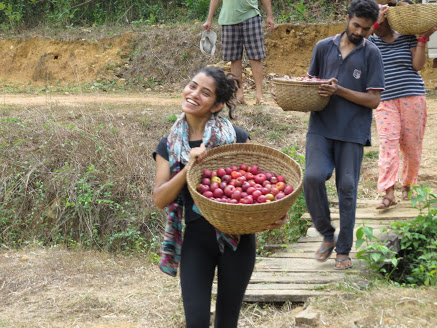
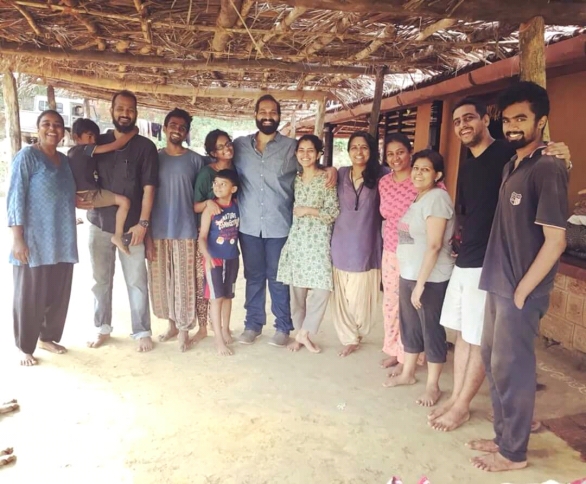
Two girls from Mount Carmel College,Bangalore - Harita and Meghana! One is known to BuDa for many years and the other was experiencing the tough life fresh.They stayed in Angadibail forest for thirty days without internet, without electricity without shampoo, conditioner, toothpaste ,without fan far away from comfort zone.Went back home grown ,stronger, and changed .Angadibail forest..Beera ,Rangi (you named her !) and Eshwaranna are going to miss you girls. Thankyou ! We also thank Advithi who supported you with your project in the forest -BuDa team
silent nights in the forest
Sometimes wanting to stay back,
Sometimes wanting to go home,
Sometimes wanting to feel the
forest,
Sometimes wanting to feel
family,
Sometimes learning,
Sometimes pushing
ourselves
Here,
I go back home GROWN, STRONGER
and CHANGED .
Taking things,
Taking memories
Taking love
WILL BE BACK SOON…..
Love for stars,
Love for forest,
Love for nature,
Love for earth,
LOVE NEVER DIES!!”
We both believe the poem is not enough to
describe the internship in Angadibail. Probably it is just 0.01pc of our
adventurous experience there. For us city girls, the time there we had was a
blessing- away from home, packed off in and around the small house amidst the
lush green forest.
While we woke up to screaming alarm clocks here in
Benguluru, the horseflies annoyingly buzzed and woke us up every single day
without fail! Walks with our ‘Beerappa Swamy’ to get milk was what we loved to do-
first thing in the morning.
Eshwaranna teaching us how to arrange paddy hay
Kutri- stocking paddy hey for the cows
our cooking routine
Harvesting ground nuts
From experiencing night forest walks to eating jackfruit papads, from learning constellations from Miya Bhai to suspecting a cat to be a leopard in the dark, from building mud walls to helping Eshwarnna prepare for the monsoons, from walking in search of network to call home to walking to a far neighbor’s house to see election results, from doing coconut harvest to ‘weightlifting those sacs’, from surviving the nights on solar lanterns to waiting for the first rain of the monsoons, from fighting paddy allergy to having full-moon light dinners, from cooking on fire to eating charred food, from waiting for guests for the kokum harvest to craving for the silence of the forest each night, from mixing kokum preserve in the hot sun to drinking lemon grass tambuli- WE HAVE DONE IT ALL!!
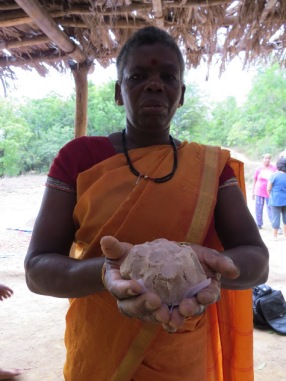
Eshwaranna explaning Mann kaayi -a medicinal mud ball he found in the monsoon
Advithi helping us in illustrating summer medicinal plants of Angadibail
Our internship was to document ‘Summer
medicinal plants of Angadibail’. That we would say was just less than half of
the things we did there. From enjoying every meal to learning the value of
food- we learnt it all. The ride was super bumpy filled with lots and lots of
new things that we learnt. Realizing the forest has treasures at each step we
take, understanding the medicinal value of ‘weeds’, listening to calls of
various animals to going to have a hot water bath every night after a long
day’s work- the experiences have made us more stronger, responsible, confident,
humble, calmer and most importantly turned us into fighters- we are ready now
to take upon any challenge we face!
Kokom harvest festival
We are forever indebted to the organization
and everyone who help us survive those tremendous thirty days
A beautiful note by our Mungaaru participant: Pallavi Raut Photos: BuDa Folklore
A trip that reminded me about what are the basic necessities and how we take some of the luxuries for granted.
A trip that brought me down to earth literally!
A weekend with team ~~BuDa folklore is a true digital detoxifier.
Clean air, ample fresh water, good food(yummy too!), clothes - muddy from hard work(and play), a cozy house and a community of people with a similar mindset! What else does one need!
No electricity, no gas, no mobile network!!!! But so much fun!
An experience all urbanites, ever digitally connected but rarely actually connecting, must experience.
One'll have a two-way realization.
First is that a human being really has very few needs(not wants!). We're unnecessarily adding on too many things to our lives and becoming hooked onto them as we go higher up economically. And while adding this we're leaving behind sensitivity, self-reliance, empathy, awareness of the neighborhood, physically hard-working capability, ability to appreciate simple pleasures and a whole lot of garbage.
Secondly, one gets to learn about the day to day difficulties faced by our rural counterparts.
Where there is fresh air, there's also smoke from cooking and heating water with wood.
The tremendous amount of work involved for growing grain of rice(The event, 'Mungaru', is all about paddy plantation).
The distances one has to go for buying basic things or reaching basic facilities if living on the farm.(Forget about Big Basket, Swiggy and Amazon!!).
Grinding in millstone instead of a mixer in case of no electricity.
Exposure to only one community leading to a more judgemental society in some cases.
There are pros and cons for everything. Finding a balance is key. Asking young men and women in villages not to go to cities is not fair, they too should get a chance to taste economic freedom and luxury and different cultures but not at the cost of forgetting the roots like what has happened to a lot of us.
Such drops of efforts like the one being done by Buda may go a long way in bringing some of the urban folks, who are done breathing smoke and waiting long hours in front of red light, back to villages with new energy, ecological awareness and ideas that will help fuse the gap between urban and rural. Especially if the ideas are executed with local people's trust and by making use of their expertise, skill and knowledge.
The highlight of the event for me was seeing a teenager find it more meaningful to celebrate her 16th birthday with a group of strangers far away from family and friends just to be able to sow some paddy and hear some folktales and be in midst of mother nature.
Thanks, team Buda folklore for giving me a heartwarming and eye-opening experience!
Mungaru acknowledgments
Thanks, Sumeru for insisting I go. Thanks to Sara for introducing all of us to BuDa folklore and Savitha akka.
Thanks, Vinay and Mihir for making this happen and enjoying this as much ( or more)!
Thanks, Savitha akka for such a wonderful idea to give us this exposure and experience. May your organization grow and have a wide reach!
Thanks, Shanti amma for your passion to learn, document and share local and folk traditions, stories, recipes, medicines.. the list is endless...!!!
Thanks, Gowri Akka and Shalini Akka for giving us wonderful food sitting in front of that smoke all 3 days!
Thanks to Pranav for hot water and all the volunteering!!
Thanks to Madhavi and Joel for salads and juices and for serving and so much of fun singing and talking!
Thanks to Atmeeya and Uday for so many trips to get vegetables and to drop and pick up and for kabaddi!
Thanks to Ishwar Anna, Gopi akka, Padmavati akka and nuggli akka for teaching us baby steps in paddy farming and for making our stay authentic with folk songs and stories!
Thanks to Pavan, Anu, Om, Shakthi, Anish, Sharad, Chhavi, Prakash, Pradeep, Pankaj, Yogi, , Bhavna, Mithali, Aastha, Abhimanyu,Divya, Elbin, Aditi, Pratyush, Meenakshi, Purushi, Jyothi,Prarthana from aravani project.
Thanks also to cat( rangi) and the dog(beera) for adding to the eclectic mix!
When you travel in the car on the highways of the Western Ghats and Coasts of Karnataka you may suddenly notice these strange pile of disposals just beside the road..
At first, it looks like a pile of garbage.
But if you look a little closer, you may see old brooms, broken baskets, cane cradles , old saree, broken pots, grass mats, and beside that colorful green bangles, packets of salt, coconuts, coins and even wooden figures and a toy cart .
I have often wondered about these strange heaps.
These are not ordinary garbage disposals. It has got a cultural history and interesting rituals and belief followed by locals.
Locally, these bundles are called Maari Hore (ಮಾರಿ ಹೊರೆ) and are connected to Maari Amma, a folk goddess associated with epidemics and disease. What looks like a heap of discarded things is part of a ritual that has been carried out in villages of the Western Ghats and coastal Karnataka.
The tradition of Maari Hore (ಮಾರಿ ಹೊರೆ) is rooted in the old practice of cleaning the entire village when diseases such as chickenpox and smallpox spread. Maari Amma, the village goddess associated with these diseases, was believed to protect the community.
Near Sagar western ghat highway 2019 June
This waste bundle is called 'Maari hore"(ಮಾರಿ ಹೊರೆ )in Kannada.'Maari' is the folk Goddess/Deity of misfortunes and epidemics diseases., who is worshiped to seek her blessings for prevention of diseases like smallpox, cholera, plague and also natural calamities. The word ‘Maari’ refers to contagious diseases in Kannada. It appears that originally the concept of Maari worship was conceived to drive out epidemic diseases.
Maari is not only part of ritual and belief; the association with disease has also entered everyday language. In the villages, when people curse someone, they sometimes say “ಮಾರಿ ಕೊಟ್ಲೆ ಬಂದು ಹೋಗಲಿ” (Maari kotle bandu hogali),“May Maari strike you.” invoking Maari and the disease. It is a small but interesting reminder of how deeply Maari has been woven into everyday village life—not only through rituals and offerings, but even through the language people use with each other.
The symbolic extradition of Maari, the epidemics, still prevalent along the Western Ghats and coasts of Karnataka.
No festivals are celebrated by the village in whichMaari hore is placed.
She is also known adugoolajji (ಅಡುಗೂಲಜ್ಜಿ )or gadi maari (ಗಡಿ ಮಾರಿ) (Gadi means boundary and maari is the goddess of the epidemic )Gadi Maari is always kept at the boundary of the village As time passes the village grows beyond the border but the tradition retains the jurisdiction.
How It travels :
The villagers of the next village used to carry the disposals on their head after conducting Poojas (ಉಡಿ ) extradite the idol and the bundles to the outskirts of their village. And this chain continues along with the villages until the bundle reaches the sea or a river .
What is this Maari hore contains?
The entire dump is called maari hore. Interestingly earlier these garbage bundles (maari hore) contained all eco-friendly discarded broken household items. Mostly it contained broken woven cane baskets, broken woven cane cradles,rice winnowing flat basket) brooms, broken earthen pots, waste cloths and loads of salt packets .. Deities also offered coins, green bangles, coconut as UDI.
The maari hore is also evolving ..earlier it was just a bundle of eco-friendly disposals. Now we can see the wooden statue of the female goddess and a male god along with disposal ..there is a big wooden toy cart also be offered as an imaginary goods carrier ..
the places it travels and the timings :
The photographs were taken in different years, mostly along the highways of Sirsi, Siddapur, Yellapur, Ankola, Kumta, Honnavar, Sagar and Shivamogga. Most of the photographs were taken during the monsoon. In some places, especially when the Maari Hore reaches the coast, I have also seen it during March and April.
Near Sagar highway july2019
Recent maarihore contains mostly plastic waste ..Recently vehicles are hired to lift the Maarihore when it reaches to the towns and they describe the reason that Maarihore becomes a huge pile when it is almost reaching its destination.While lifting the garbage (maari hore), salt packets offered to get rid of minor diseases and piled up by devotees around the year are also cleared.
Photo :Nandan Aigal
Photo: Nanadan Aigal
How the Maari Hore is changing
Another interesting thing I have been noticing is how the Maari Hore itself is changing.
Earlier, from what I have seen and heard, it was mainly a bundle of discarded household things. But now, along with the waste, we also see objects that clearly represent Maari Amma. I have seen painted wooden female figures placed in front of the heap, and sometimes there is also a male figure standing beside her.
Maari Amma is a female folk deity, and things like green bangles, coconuts,kumkum and other offerings are still seen in some of these bundles. But the appearance of the male figure makes me wonder who he is and what he represents. I have asked people about it, but I have not yet found a clear answer. It may be a local addition, but I don't want to assume that without understanding the story from the people themselves.
I have also seen wooden toy carts placed along with the Maari Hore. Earlier, the bundle itself was carried physically from one village boundary to another. The appearance of a cart is interesting in this context. Is it simply being used to carry the Maari Hore, or has the cart itself become part of the ritual? I am not sure yet.
What I find fascinating is that the Maari Hore seems to be changing slowly with the society around it. The materials are changing, the way it is carried is changing, and even the way Maari Amma is represented seems to be changing.
Earlier the bundle was mostly made up of things such as bamboo and cane baskets, old mats, brooms, broken pots and other household objects made from materials that would naturally return to the earth. Today we see plastic, synthetic cloth, metal and other modern materials mixed into it. The bundle has also become much larger in some places, and vehicles are sometimes used to transport it.
The ritual has remained, but the things that we consider as waste have changed.
That is what makes the Maari Hore interesting to me. It is not just a ritual that has survived from the past. It is a ritual that is continuously changing with the village, its materials, its beliefs and its surroundings.
I am still trying to understand these changes. Who decides what goes into the Maari Hore? Who makes the figures? Why has the male figure appeared in some places? When did the cart become part of it? And do different communities and villages have different stories about Maari Amma?
These are questions I would like to follow through the journey of the Maari Hore.
Near Sagar high way June 2019
Sirsi highway july 2019
The concept of maari hore is a great example of effective waste disposal management. The waste travels from village to village until it reaches the sea or a river. unfortunately now maaarihore is no more eco-friendly garbage bundle ..it contains all kind of plastics .. but the rituals and faith continue
.
Aug 2016 ankola,achave
A small ritual carries within it a story of health, community, ecology and changing material culture.
As an attempt to keep my feet off my home city of Delhi and close to the nature, I found myself Wooffing in the lush hues of green and brown and yellow in the Angadibail Forest of Uttar Kannada. With birds chirping through a silence so subtle, a local lady helped me to the Angadibail home of Buda Folklore where I was to volunteer for their upcoming Kokum Harvest Festival. And Kokum did I harvest, climbing those slender trees like my pre-evolution monkeys. Big red fruits, some sweet, some sour all from trees to baskets to the processing units that were men and ladies and kids; separating the peel, juicing the pulp, collecting the seeds, all in all where nothing goes to waste.
Want some? by Buda Folklore
“Come with an open mind and you shall find the learning you are looking for,” said Dr. Savita Uday or Savitakki, as I like to call her, when I expressed my desire to work at her farm a few weeks into April. And learning did I receive, learning packed with laughter; with stories and skills from the native Halakki and Siddi tribes; with dance and healthy food; good bamboo music to suit every taste and butterflies flying in my face.
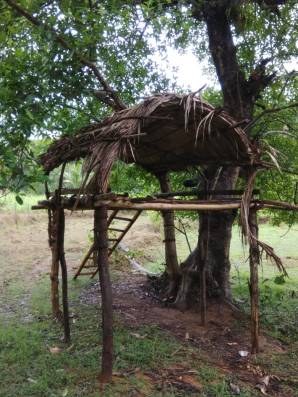
Machaan
The first morning of the festival was Savitakki waking us girls with her musical “hey girls, we need some help”. The previous night, Harita and I had retired to one of the Machans, where this wonderful platform under a Fig tree became our bed under the starry forest night. With this began a day of the festival days where I was entrusted with the morning herbal tea for the Buda community while the new friends Harita and Atmeeya sang along taking turns sweeping and mopping.
Kokum, which until now was only an appetizing squash for me, turns out, is an all rounder fruit finding its uses in medicines and cosmetics too. While on one hand we got to relish the refreshing cardamom flavored Kokum Sherbat and spicy Kokum rassam, on the other we had our lovely Gopi akka (a Siddi) let us grind boiled Kokum seeds from the year before. The de-husked and ground seeds were later boiled to make kokum butter, a very important ingredient in Atmeeya’s organic soaps. And these soaps I can swear by them to trash all my Nivea and Dove products, for they moisturize as they bathe, and their scents are meant to waft off you throughout the day.
Gopi Akka with some fresh Kokum Butter by Buda Folklore
Riding through the bumpy forest on a Bolero Pickup we’d go to harvest a lot of the day. With Eeshwaranna, the arms of Buda, climbing the topmost branches, it literally rained Kokums. But to Savitakki’s expectations, this year’s was a scant produce with Kokum barely ripening, growing to the size of green apples even. All thanks to the climate change.
The baskets filled with the fruit nevertheless had our hands full and separating the fruit parts where the good peels went into making fruit preserve and not so good to dry in the sun. The seeds were to be under the sun too till they became dry enough for butter making. So yeah, nothing went to waste, not even the stem heads for they too found their place in the soil under the banana trees.
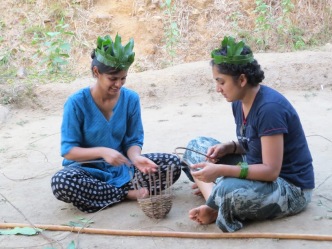
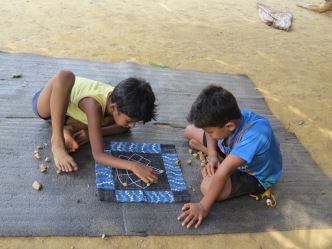
While Kokum harvesting and processing marked the lengths of our days, the afternoons relaxed into lazy naps and board games that Advitee had hand stitched into beautiful cloth patterns. The evenings had Anvay and I walk to meet the neighbors and bring home another round of milk, sharing our set philosophies and debating over worldly politics on the way. We’d come back to find the Buda community engaged in making baskets out of tree vines, or crowns out of mango leaves.
One of these evenings, to my pleasure, turned out to be a Siddi dance lesson where Raghavendra and Mahabaleshwar anna sang and performed their native Konkani songs ‘Muiyan cha Kottaw’ and ‘Miya Gailo Mumbaik’. The Dholak that they played to set the beat right had us all dance our souls out with the wildest expressions brimming off our faces. Prabodha who turned out to be the best performer, rolling on the floor even, had Padmavati Akka laugh her heart out. And Padmavati Akka, what a brilliant storyteller she is!
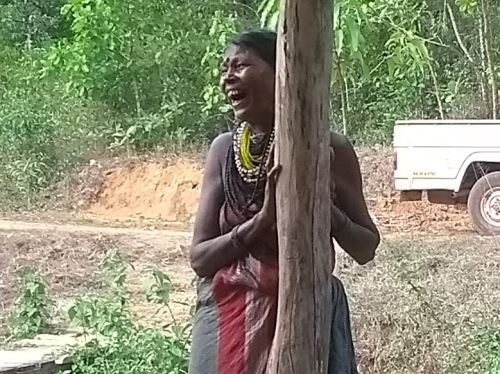
A Halakki granny, Padmavati Akka in her blouse-less wraparound of a saree and yellow and black and white beads trailing around her neck, one night sat with her lantern lit face under the starlit sky. She took the stage which was to later become our bed, walking us through the stories of ‘Vakkal Gowda’ and ‘Devvad Kathe’. To the least knowledge of Kannada that I have, Padmavati akka’s expression and gestures became a resting reliance. Such a performer, I swear! I have never seen anyone enjoy their own act so much. She just couldn’t stop laughing while telling us Devvad Kathe, this funny fable about a son’s dance with the demons. While Harita’s translation helped us understand what was being told, a bigger thanks goes to the performance itself for it had no language barring the flow.
Padmavati Akka by Buda Folklore
To relish the native flavors, we had homely meals of beaten red rice, new rassams every night and curry mixes and sabzis with a dessert of Kadabu or ragi barfis to top with. Thanks to Soumya akka for all her kitchen wonders of taste and aroma and Uday uncle for his score of pickles and chutneys. That Lemon and Chilly Pickle stood out to be my personal favorite.
Burping our guts to relive the tastes we edged towards the nights which had us race or call dibs on any of the two Machaans. Some would peacefully settle for the attic and Veranda or they’d settle for the platform under the sky. And under the sky did I sleep for most of the nights, sometimes confusing fireflies for shooting stars, on others fireflies for predator's eyes.
The diversity of cultures, energies and philosophies that the festival brought together wafted in the breeze of the Angdibail Forest through the day. While it taught me everything from the values of the beloved fruit to the lost art of basket weaving and all the dancing and singing that came with it, it incited in me an inclination towards working in a community. No meal can taste better than the one that is touched by the hands of all the people who are later going to eat it. Such solidarity and harmony seems lost in the home city with cellphones taking space on the dining tables and with one or two designated members of the family arranging the food for all. Here, with no connectivity with the outside world, a diverse lot of like minded people came together, and singing the best of Rafi and Kishore, cooked for one another. This for me was the best family I’ve ever been a part of.
One Big Fat Happy Family and some Skinny People by Lakshmi Arvind
The farmhouse of Angdibail – its comfortable attic and homely kitchen; the dining area with a view of the farm and ‘Moti Gudda’ in the distance; the pets, Beera and Bella; and the constant chimes of everything that decorated it – had through the week-long festival seen a worldly share of ideas and appetite. From experimenting with Kokum’s culinary abilities, to dancing with the Siddis; night walks in the forest and predicting rain, we all ecstatically edged towards the end of the festival. And soon, with the participants leaving, the days of the festival that had the forest echo with laughter and joy ascended to the music of the chirps and rustles of the forest, once again.
And so came the last night of the calm and it brought with it light drizzles which had all who remained running around to save the produce from the year’s harvest and processing. Marking a brilliant end to the bustle in the calm, the rain went away soon after. And soon after came the moon lurking out of the skies and it lulled the forest good night.