Hanmi -a talented creative master artisan
Hanmi is from the bank of the river Sharavathi .Her crativty in art and crft closely connected with the land and the nature where she lived
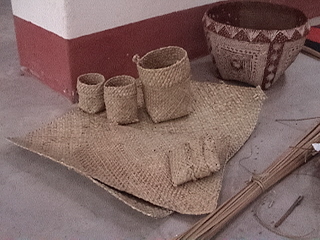
She is a master in oral folk literature of Ramayan and Mahabharata, She is master in folk art and other craft skills like mat weaving, making containers and pot holders.Her skills extended in making torans with paddy shoots ,For her art work she makes her brush and prepares her colours from the nature .
If the unexplored.. untouched.. dying folkart called ShediKale is still surviving it is because of Hanmi This ritualsitic art has no place in their community because the rituals are not in practice . Now it is surviving as an art form in Hanmi,s crafty hand because she values it . (Pl see the article Shedikale in this blog)
http://buda-honnavar.blogspot.com/2010/08/folk-art.html


Hanmis a visiting artisan . a resource person an art professor at buda folklore research center. Students call her hanmkka and she is fun,affectionate , and a very strict teacher.


Since 4 years more then 900 students interacted with hanmi and she is one of the main resourse person at our Folklore Center .


Her paddy Torans (Door hangings) are great expressions of her creativity and her intigarated weaving pattern

Folklore Research center documented her Tribal Ranmayana and Mahabharata and other oral literature which would have been lost otherwise.
Hanmi is from the bank of the river Sharavathi .Her crativty in art and crft closely connected with the land and the nature where she lived
She is a master in oral folk literature of Ramayan and Mahabharata, She is master in folk art and other craft skills like mat weaving, making containers and pot holders.Her skills extended in making torans with paddy shoots ,For her art work she makes her brush and prepares her colours from the nature .
If the unexplored.. untouched.. dying folkart called ShediKale is still surviving it is because of Hanmi This ritualsitic art has no place in their community because the rituals are not in practice . Now it is surviving as an art form in Hanmi,s crafty hand because she values it . (Pl see the article Shedikale in this blog)
http://buda-honnavar.blogspot.com/2010/08/folk-art.html

Hanmis a visiting artisan . a resource person an art professor at buda folklore research center. Students call her hanmkka and she is fun,affectionate , and a very strict teacher.
 |
| mat weaving with Shibumi ,Bangalore students |
 |
| With Srishti School of Fashion.Design and |
technology
 |
| At The Valley School,(K.F.I.)Bangalore |
 |
| With Karnataka university students |
Since 4 years more then 900 students interacted with hanmi and she is one of the main resourse person at our Folklore Center .
Her craft skills not only in the folkart but she is a matweaver and she makes beautiful mats and catainers with the river reeds from Sharavathi river bank.,She makes pot holders with paddy hay which is also a dying skill as people stopped using earthen pots
Her paddy Torans (Door hangings) are great expressions of her creativity and her intigarated weaving pattern
 |
| Recognized and honored.. |

Folklore Research center documented her Tribal Ranmayana and Mahabharata and other oral literature which would have been lost otherwise.


