Sunday, April 8, 2012

Summer nostalgia…


Summer nostalgia…
Growing up in small town in Honnavar was great in many aspects, but the one that's shaped me the most is the freedom to roam, explore. We had endless energy..
We never knew about Switzerland but only grand ma’s backyard, that was simply enough and that has given all the memories for the rest of the life…

Everyone generation has a story to tell and memories to re-live, of how their summers were spent. Nostalgia is the flavor of the season that I now so often indulge in…. where summer was about people, mangoes, going to the village fair.. , Catching fish in the streams, collecting wild berries, preparing kaaju juice.. raw mango pachdi, Listing to the radio under the shade of mango tree.. vividh-bharati.., aalemane … and play and play all the time.

So it's the beginning of summer holidays! I love this ode to careless, free summers..
Bright mornings …cool evenings.. Summer showers... Birds chirping everywhere..


Now, summer is felt, not only because of the scorching heat, but also for the hype that surrounds it. Everything around is buzzing with summer camps, summer fashion, summer holiday destinations, summer workouts, and more. There is more to summer than scorching sun; more hype than heat. Summer seems to be the happening thing around.


I look back at the summers we had as kids… where it was about fun, holidays, and of doing nothing and everything. Summer was about more of family, fun and frolic. There was no homework to complete, no extracurricular classes to attend and no summer camps to participate in .Life was so less complicated in those days. Devoid of cutting edge technologies and concrete jungles, there was more to life and living. Summer was not about air conditioners, gas-guzzling generators, ice skating rinks or blue colored mock tails.. It was about charting one’s own activities, time tables and living for the moment.

Yes, it was different then. It is a lot different now. I do long for the back yore days… but there is still so much at the moment to bask in. To learn. To feel. To enjoy. To live. Often I wish to go back, back to that point in life when everything seemed simpler.


Wednesday, April 4, 2012

Rooted in tradition


Rooted in tradition

HERITAGE

Buda Folklore, an NGO headquartered in Honnavar, has a vast database on various tribes and indigenous communities of Uttara Kannada, writes Sumana Bharadwaj


Repository of knowledge: Tribals themselves are  resource persons at Buda Folklore. Their love for folk heritage and culture is so deep that this scholarly couple from Honnavar, N R Nayak and Shanthi Nayak, chucked their careers as professors, and took to safeguarding the rich culture of indigenous communities of Uttara Kannada.

They have meticulously documented their extensive field and research work of over four decades in an effort to preserve native knowledge, folk culture and oral traditions for posterity. Between the two of them, they have authored over 80 books on folk literature, arts, crafts, dance, food, drinks, songs, games, medicinal plants, costumes, etc. Today, carrying on this legacy forward is their daughter Savita Uday. She founded an NGO, Buda Folklore, to save and share the precious knowledge. Headquartered in Honnavar, it has a vast database on various tribes and indigenous communities of Uttara Kannada and is a focal point for study and research of folk heritage.

Connecting with nature

Savita grew up in the lap of nature in the fertile green lands on the banks of the River Sharavati watching her parents interact closely with the local tribes. Her own interaction with the tribal communities however, happened during her research for her doctoral thesis on tribal ornaments and costumes. What fascinated her most was the strong connection that the tribal communities had with their surroundings and as a consequence an immense respect for the same.
Their lives were deeply intertwined with their surroundings. Their art, culture, food habits, lifestyle, everything reflected the ecology they were part of. So, when her own marriage took Savita out of Honnavar to bigger cities, she was engulfed by a sense of disconnect to surroundings that existed in the cities, that left her longing to go back to the warmth of her home among the rivers and valleys.

To urbanites who earn their degrees, earn a living and live a life within the confines of four walls, whether the four walls were on a hilltop or on a riverside or a valley hardly mattered.

The abuse of nature by man in cities is precisely because of this disconnect, it seemed to her. In contrast, the intimate connection that the tribals enjoyed with environment was heartening. The simplicity and wisdom inherent in their way of life stirred her into action.

As she says, “When you connect with something, you learn to value it and you want to bring its essence into your own life. Somewhere deep down I connect with these people and would like to see these cultures preserved for posterity.
There is lot of wisdom in indigenous cultures and it would be a shame to lose it all and perhaps repent later. It is important to recognise the value right now and work towards preserving it. I believe modernity and local cultures can coexist only if we value local cultures enough to embrace them proudly.”

Tribals as resource persons

What is unique about Buda Folklore is that the tribals themselves are resource persons. They are ‘guides’ on study tours and ‘honorary professors’ at workshops conducted as part of the awareness programmes. Participants get to interact, live and learn from tribal communities in their heartland which is indeed a unique and enriching experience as many of those who attended these programmes would testify to.

Buda also facilitates research and internship programmes for students, social scientists, food technologists and designers. Apart from running these programmes, Savita is associated with various schools where she inspires children to get involved in various projects with very hands-on, on-field learning.

Savita’s philosophy as an educator is that children learn best outside the confines of a classroom. So her classrooms could either be a herbal garden or a riverside, a forest or a tribal village. She conducts workshops as well for the children on different facets of the folk life, be it a workshop on the beverages of the tribes (of which Savita says there are about 300 documented varieties!) or it could be about the 100 varieties of greens and tubers used in daily cooking (leaves one wondering whether global food shortage is really an issue) or it could be about the tribal puzzles and games. The workshop could be also be hands-on study of materials used in their crafts and arts or their rich oral tradition.

Another aspect that sets Buda Folklore apart is that the focus is on educating people about tribal culture, not on commodification of their art. “Commercial activity may give them a living and a reason to hold on to their art, but by just putting a price on their products. We can never learn to value and appreciate the product in its entirety, because there is a cultural context linked with every art form.

Displaying tribal crafts at lifestyle exhibitions in the cities or having a dollu-kunita performance (a tribal dance form) in a mall is meaningless for both the tribals as well as the urbanites, since the context is missing.

The time and effort that goes into making the products or the months of practice behind the performance and the significance behind it all for the entire village which is involved in the preparations just cannot be fathomed as outsiders. If instead the urban folk come to the tribal heartland and interact with them and see them at work, the experience is entirely different! This is part of building that connection which is my buzzword,” Savita says.

Museum and library

Savita has set up a museum and library at Honnavar. The museum has a rich collection of various arts and crafts from the daily and ceremonial lives of the local community. The library with its well-researched database and large collection of books related to folklore is indeed a treasure trove of knowledge.

Talking of future plans, Savita’s dream is to start a learning centre which would act both as a cultural centre and a facilitation centre for the community.
Work has started in part already towards the same, she says. People from urban areas can visit and participate in various programmes to get a better understanding of the tribal culture by experiencing it firsthand. People from rural areas can avail of the facilities at the learning centre to carve out a sustainable livelihood for themselves. One only hopes that Savita’s tribe increases.

Tuesday, February 14, 2012

Holy Scrap!: I was Featured !

Holy Scrap!: I was Featured !: Well, not really, but it makes for good copy, right? :-) It was more of a mention on my Dutch fellow-quilter-blogger's blog. And it was more...

Wednesday, February 8, 2012

Rediscovering the forgotten recipes and the lost art of local traditional cooking…


Food is always given utmost importance in any culture and every community has its unique cuisine. A closer observation reveals that the local environment has a strong relation to these food practices. While there is science involved in knowing the right measure of ingredients and when to add to what - like in a chemistry lab; there is creativity and craft involved in using things the nature/environment has to offer and making food look appealing on that banana leaf.


Unknown or forgotten, the diversity of local preparations has been ignored in the rush to modernization and western way of eating practices. 


Many a age old recipes, the tools and the techniques buried in ancient kitchens,. The skilled mothers lost their recipes and skill in the name of modernity. 


Have age old local traditional recipes already become extinct? Or, with the changing eating patterns of today, will these traditional recipes be lost forever to the world?

Buda folklore looks to revive the dying culinary art of this region which is slowly fading out with the advent of kitchen gadgets and instant ready mixes.

The workshop is about
Documenting and Rediscovering the forgotten Recipes..  forgotten  skills and  forgotten  techniques …  forgotten  flavors and the lost art of real traditional cooking
This culinary retreat is for a period of 4 - 5 days. 


                                     It is important to purchase local products from small independent farmers
The day would be spent with visits to local markets, 


a leisurely afternoon is spent cooking and documenting the process of forgotten recipes 
It includes documenting the skills and techniques of cooking and have hands on experience of some unusual local recipes, 


A culinary tour* around the village. This tour, will give participants an insight into cooking practices (tools, skills and techniques) in these homes. 
.
At the end of the workshop, we would like to put together these recipes with respect to the cooking methodology, the associated local wisdom, history & folk culture and the nutritive value of these foods  in a photo journal form and & CD. 

If you'd like to experience this culinary journey, join us any time between the 19th and the 24th @ the Buda Folklore Research Centre, Honnavar.

Look forward to seeing you !

Sunday, January 1, 2012

Quilting Workshop @Bangalore


Quilts and other cloth-based narrative art are part of many cultures. Quilts serve as both personal and communal objects and are a form of artistic expression too. These are often made by hand collaboratively using materials such as scraps of cloth.


When these scraps of cloth are put together, there is much more than gross geometrical patterns .... they tell a story about their creator, the historical and cultural context of their creation through the choices made in design, material and content.
Haliyal is a small town in Uttara Kannada district. In each house you will find women making quilts for the monsoon season. After a tiring day's work,the women settle down in the verandah to work on their quilts. An old sari is used as a backing for the pattern created from pieces of used cloth. The colorful bits of cloth are often lovingly gathered from family and friends over a period of time.The quilting practice also helps understand how women in villages / small towns always found use for scrap or the smallest of things. It is also interesting to observe how they find creative use for it :) To gift a quilt, sewn with old clothes of the family, for the daughter who gets married, often carries fond memories of the maternal home.

                                     Our very patient teacher ... With high standards and a great sense of humor!Poornima Bhola 


Nirmalakka from the Haliyal village and stitches quilts. Her needlecraft shows a remarkable expertise and originality. She will be sharing the techniques and patterns involved in the process of stitching a quilt. It is an opportunity to work under the guidance of a traditional quilt maker. 

The details are given below. Do come along if you are interested and do pass it around as well.
Thanks


3 days Workshop on: The Art of Quilt making

Date: Jan26th to Jan28th
Time: 10am - 5pm
Venue: #117, Vakil Garden City, Near Talagattapura Police Station, Kanakpura Road, Bangalore 
Contact: 08026968117
Email: folkloreindia@gmail.com
Pl Note: Participants will get to create a mini quilt and will learn traditional quilt making stitches. 
Please write to us if you are interested for further details.

More links:


Participants write:

Carol Shatananda

Hey Savita, 

:) Nice to see that there is another workshop on! All the best. 
Is Nirmala akka doing it again? Please give her my love and tell her that I think of her with much fondness. How are you doing? 
I'm not sure if I told you but we've moved to Toronto so I am going to miss this. 
Well, I hope it goes very well. And I hope this time the participants will do more of the write-ups. 
Love,
Carol

Meetali Mukherjee on face book wall 
I had the most fulfilling 3 days of my life attending the last workshop. That mini quilt started off as our dining table centre piece and now functions as Rahul's laptop coaster and doubles as a mousepad too! Nirmalakka is a champ and Savita Uday's commitment is inspiring.

Poornima Bhola 
What a wondering soul satisfying workshop this was! Lucky to be part of this handmade journey.


Tuesday, November 15, 2011

Our Master Artisans-Hanmi

Hanmi  -a talented creative master artisan


 Hanmi is from the bank of the river Sharavathi .Her crativty in art and crft closely connected with the land and the nature where she lived
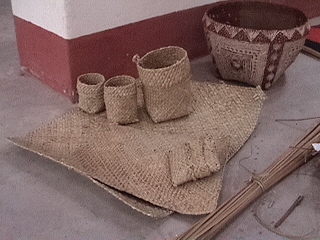
She is a master  in oral  folk literature of Ramayan and Mahabharata, She is master in folk art and other craft skills like mat weaving, making containers and pot holders.Her skills extended in making torans with paddy shoots ,For her art work  she makes her brush and prepares her colours from the nature .

If the unexplored.. untouched..   dying folkart called ShediKale is still surviving  it is  because of  Hanmi  This ritualsitic art has no place in their community because the rituals are not in practice . Now it is  surviving as an art form  in Hanmi,s crafty hand because she  values it  . (Pl see the article Shedikale in this blog)
                      http://buda-honnavar.blogspot.com/2010/08/folk-art.html


Hanmis a visiting artisan . a resource person an art professor at buda folklore research center. Students call her hanmkka and she is fun,affectionate ,  and  a very strict teacher.


mat weaving with Shibumi ,Bangalore students


With Srishti School of Fashion.Design and 
technology


At The  Valley School,(K.F.I.)Bangalore


With Karnataka university students


Since 4 years more then 900 students interacted with hanmi and she is one of the main resourse person at our Folklore Center .


Her craft skills not only in the folkart but she is a matweaver and she makes beautiful  mats and catainers with the river reeds from Sharavathi river bank.,She makes pot holders with paddy hay which is also a dying skill as people stopped using earthen pots


Her paddy Torans (Door hangings) are great expressions of her creativity and her  intigarated weaving pattern


Recognized and honored..

 Folklore Research center documented her Tribal Ranmayana and Mahabharata and other oral literature which would have been lost otherwise.


Traditional Baskets and other weaving crafts with natural fibers in Uttara Kannada-western Ghat region

  While  weaving craft with natural fibers  is one of the widest spread crafts in the history of any human civilization, it is hard to say j...